 Manifested Healing
Chapter 09
You Come Home Carrying Everyone Else's Day
What it can look like
You know every mood in the room, but have to stop and think about your own.

Manifested Healing names the patterns that difficult experiences leave behind, rebuilds the self underneath them, and shows you how to manifest the life that follows from her.
Thirty-two chapters in six parts. Written to be read out of order, on the nights you only have one of them in you.
There is a reason you do these things, and there is a way to work with them. Almost every woman reading this thinks she is the only one. You are not alone in it.
Chapter 09
You know every mood in the room, but have to stop and think about your own.
Chapter 12
You call yourself the calm one while your jaw does the work of holding it in.
Chapter 02
A five-second conversation becomes evidence about your entire life.
Chapter 14
You hear yourself agree before you have checked what you actually want.
Chapter 01
Nothing is technically wrong and you still cannot relax.
Chapter 22
Someone asks what you want to eat and you genuinely do not know.
“You are responsible for your healing. You were never responsible for your harm.”
Overthinking, people-pleasing, and self-doubt are not personality flaws. The book helps you see what keeps them going and what to do next.
You say yes before checking what you want, stay quiet when something bothers you, or apologize just to end the tension. The book gives you one sentence that buys you time, and three more to use once you have it.
You search for what you should have said, what the other person meant, and whether you missed something important. A short writing exercise helps you separate a real problem from an overthinking loop.
You look at a small task, know exactly how to do it, and still cannot start. You feel stuck, and you have started calling it laziness. You are not lazy. The book explains what is actually happening in your body, and gives you two pages you write on a good day and follow on the bad ones.
You ask what everyone else would do, change your answer, or wait until the choice disappears. The book helps you make small decisions and collect real evidence that you can trust your own judgment.
You read every mood in the room before you notice your own, and by the evening there is nothing left over for you. The book gives you a ninety second way to put down what was never yours, and a page for whose day you keep carrying.
It arrives at a birthday, in a supermarket, on an ordinary Tuesday, long after everyone else has moved on. The book gives grief one hour a week with a beginning and an end, so it stops taking the other six days.
And more throughout the book.
The six parts move through overthinking, people-pleasing, anger, boundaries, grief and self-trust, and end in manifestation.
Recognize the patterns that still appear on ordinary days and find clear language for what you are carrying.
Separate your own feelings and responsibilities from everything you have been carrying for other people.
Work with anger, boundaries, the things you never said, and the space you learned not to take up.
Meet the grief that arrived late, the apology that may never come, and the parts of your life that closed before you were ready.
Hear your own preferences again and notice everything you stopped wanting, doing, or choosing without ever deciding to.
This is where the healing turns into manifestation. You build the woman first, and the life follows from her, because what you can hold on to is decided by who you believe you are.
Thirty-one practical exercises, each with clear instructions, a reason to use it, and the time you need to set aside. Here are three examples.
You are never asked to do everything. The book helps you choose the practices that fit what you are dealing with now and leave the rest for later.
Screenshots from Facebook posts shared after reading Manifested Healing.
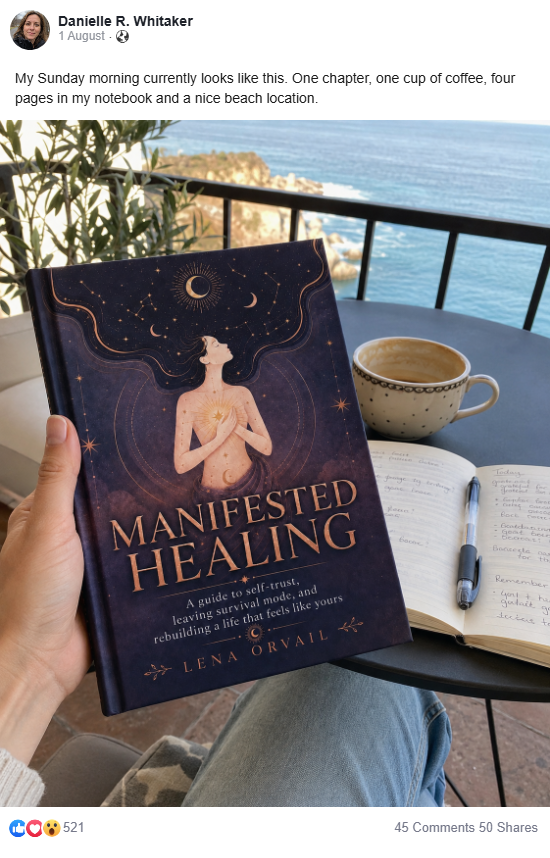




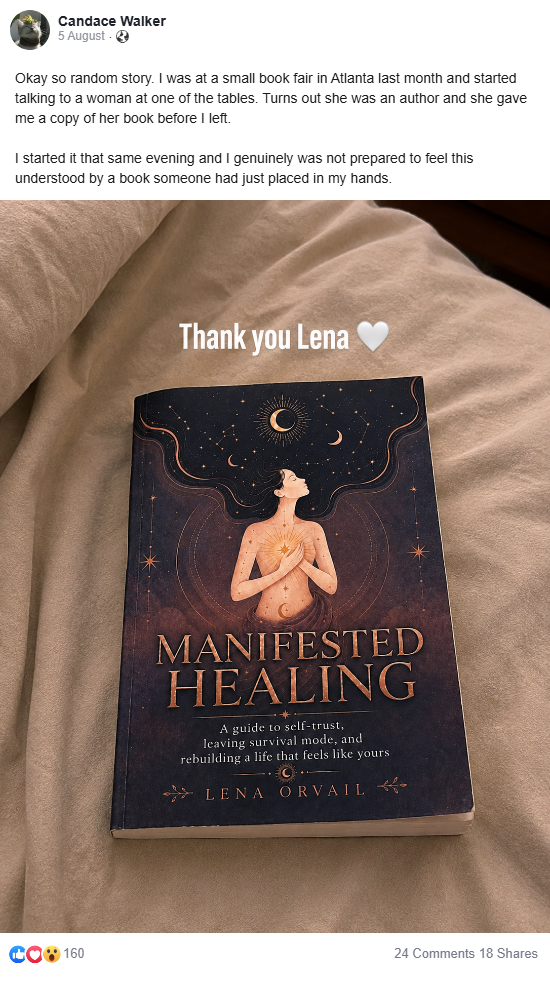



Click a screenshot to enlarge. Use the arrows or swipe to see more.
Lena writes about self-trust, boundaries, people-pleasing, grief, and the habits that can remain after difficult experiences.
Lena began writing down the questions she could not find clear answers to: why calm can still feel unfamiliar, why a boundary can bring guilt, and how self-trust is rebuilt through ordinary decisions.
She later trained as a therapist and turned those years of notes into clear explanations and practical exercises women can use in daily life.
Start with one small pause. Say let me check and come back to you before answering one question this week. That pause gives you time to hear your own answer—and it is the kind of practical change the book builds on.